




Your swim gear plays a massive role in the quality of your workout or race day performance. When chosen wisely and maintained properly, your equipment enhances your comfort and mental focus in the water. Conversely, poorly fitted gear can quickly become a massive source of discomfort and a major distraction.
Here is a simple three-step method to optimize and care for your swim gear, using your most critical tool—swimming goggles—as the prime example.
Step 1: Choosing the Right Gear
Your equipment needs to match your anatomy, your training goals, and your budget. Never hesitate to test out a few different models before making your final decision.
- Comfort: You will often wear them for over 30 minutes straight; they should never cause pressure pain or bruising around your eye sockets.
- Field of Vision: Certain low-profile racing models reduce peripheral vision, which can feel claustrophobic or disorienting for some swimmers.
- The Seal (Waterproofing): If your goggles are leaking, they are either fundamentally poorly shaped for your face type or incorrectly adjusted.
- Fogging: Look for lenses with a high-quality, factory-applied anti-fog coating, or keep a dedicated anti-fog spray in your swim bag.
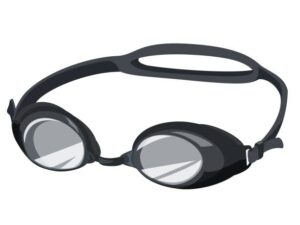
Step 2: Properly adjusting your swim gear
Even the highest-end gear on the market will fail or feel miserable if it isn’t adjusted correctly.
For goggles, take the time to fine-tune the strap tension and the width of the nose bridge (if yours features interchangeable nose pieces). The fit should feel secure and stable without requiring excessive, headache-inducing pressure to keep the water out.
Step 3: Maintenance Rules for Longevity
Over time, chlorine degrades silicone straps, lenses get scratched, and anti-fog coatings naturally wear thin.
Implement these simple post-swim habits to drastically extend the lifespan of your gear:
- Rinse your goggles thoroughly with fresh, clean water after every single session.
- Store them in a hard case.
- Regularly inspect the elasticity and integrity of the straps to prevent a sudden snap on the blocks.
Coach’s Rule Book Tip: Before heading to an official swim meet or open-water race, always double-check that your gear complies with current governing regulations (e.g., World Aquatics/FINA rules). You don’t want to waste weeks training with equipment that gets you disqualified at check-in on race day.
Pro-Tips for Race Day and Heavy Training Blocks
Before a high-stakes training session or an event, make these a habit:
- Rinse your goggles thoroughly with fresh, clean water after every single session.
- Store them in a hard case.
- Regularly inspect the elasticity and integrity of the straps to prevent a sudden snap on the blocks.
Finally, never forget that your body is your primary instrument. High-tech gear is meant to complement your technique, not substitute for it.
Selecting, adjusting, and maintaining your swim gear ensures you step onto the deck ready to execute your workout with total peace of mind. Reliable, straightforward, and perfectly fitted equipment will always outperform flashy gear that doesn’t fit the athlete.