




The swimming catch is one of the fundamental building blocks of efficient technique. Yet many beginner and intermediate swimmers overlook its importance. Instead, they try to push hard against the water as soon as their hand enters, believing this will make them swim faster.
In reality, effective propulsion rarely comes from brute force. It comes from establishing a solid hold on the water before progressively increasing the pressure throughout the underwater pull.
The Catch: Why Finding a Solid Hold on the Water Matters
Because swimming takes place in a fluid environment, you must first establish a stable point of support before you can generate meaningful propulsion.
This phase is known as the catch. Rather than being a powerful push, the catch is the moment when your hand and forearm “catch” the water, creating a stable anchor from which propulsion can be built.
Once this support has been established, pressure against the water should increase progressively throughout the underwater pull.
This continuous acceleration improves efficiency, stroke length, and forward speed. In other words, swimming efficiently isn’t about pushing hard immediately—it’s about transforming a stable catch into progressively stronger propulsion.
Universal Principles of Progressive Propulsion
Whatever stroke you swim, the same fundamental principles apply.
-
Separate the Catch from the Propulsion: before pushing, you must first establish a stable hold on the water.
The more secure your catch, the more effective your propulsion will be. -
Accelerate Progressively: once the catch is established, gradually increase the pressure applied to the water all the way to the end of the stroke.
Instead of applying maximum force immediately, think about continuously accelerating your hand until it exits near the hip. - Maximize Your Stroke: the longer you maintain an effective underwater path, the more time you have to build smooth, continuous acceleration.
It is also important to remember that there is no universal perfect catch.
Every swimmer must experiment, refine their feel for the water, and discover the hand position that provides the best support. An imperfect catch rarely creates major technical faults—but it always limits propulsion.
Stroke-by-Stroke Guide to Better Propulsion
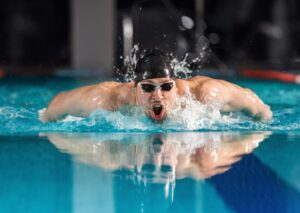
Butterfly: Building Progressive Power
Butterfly is a simultaneous stroke in which both arms work together while the dolphin kicks support propulsion.
-
The movement begins with the hands entering the water well in front of the body. At this stage, very little force is applied.
The hands gradually press into the water as the fingertips angle downward to establish a stable catch. - As the hands move beneath the shoulders, pressure against the water progressively increases. This acceleration accompanies the first dolphin kick.
- The push then becomes increasingly powerful until reaching its maximum between the hips and thighs. This phase coincides with the second dolphin kick, helping lift the arms during the recovery.
- Conversely, the overwater recovery should remain as relaxed as possible to conserve energy.
Coach’s Drill: Swim butterfly at a deliberately slow tempo.
🎯 Focus on progressively accelerating your hands from the shoulders to the thighs rather than trying to push hard immediately after entry.
Backstroke: Balancing Catch and Stroke Frequency
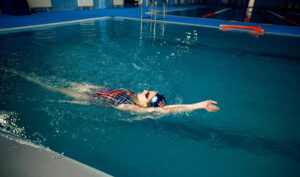
Backstroke presents a unique biomechanical challenge because shoulder mobility is more limited behind the head than in front of the body.
- The hand enters the water as far behind the head as possible while the opposite arm completes its push. During the first part of the stroke, the objective is not to generate force but to establish an effective catch.
- As the hand moves deeper into the water, the elbow bends slightly and the palm rotates into a position that creates maximum support.
- From there, the stroke accelerates continuously. Once the hand reaches the level of the navel, acceleration becomes noticeably stronger. The end of the pull resembles the motion used when skipping a stone across water.
- Maximum force is produced just before the hand exits beside the thigh.
Throughout the stroke, the flutter kick maintains body balance and ensures continuous propulsion.
Coach’s Drill: swim backstroke using a deliberately slow stroke tempo.
🎯 Concentrate on feeling three distinct phases: establish the catch, build progressive acceleration, finish with a powerful push to the thigh
Breaststroke: Progressive Power Throughout the Stroke
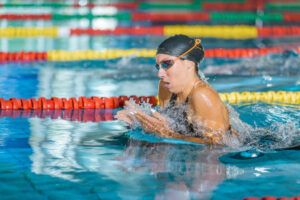
Breaststroke is probably the stroke in which progressive acceleration is easiest to observe.
Both the arms and the legs develop propulsion through their own acceleration phases.
- The arm pull begins from a streamlined position with the arms fully extended.
- The hands first establish a stable catch before gradually increasing pressure to lift the chest and allow the head to breathe. After inhalation, the arms recover quickly forward, almost as if pulled by an elastic band.
- The stroke length remains intentionally moderate to preserve momentum.
- The legs follow the same principle. The heels recover smoothly toward the hips before the feet rotate outward to prepare for propulsion.
The true acceleration occurs when the legs snap together rapidly, producing maximum propulsion and returning the swimmer to a streamlined glide.
🎯 Coach’s Drill: break every breaststroke cycle into four mental phases: arm preparation, arm acceleration, leg preparation and powerful kick
Freestyle: Developing Progressive Propulsion
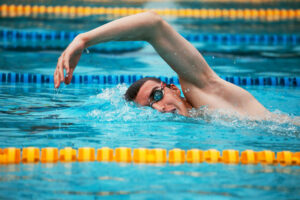
Freestyle is the fastest swimming stroke and makes the greatest use of progressive propulsion.
- The stroke begins with the hand entering well in front of the head. During this initial phase, the objective is not to push hard but simply to position the hand and forearm correctly.
- The fingertips gradually point downward while the elbow remains higher than the hand. This is the catch.
- Once the catch is established, pressure against the water steadily increases. The swimmer maintains the same hand orientation while continuously accelerating through the pull.
-
As the hand reaches the space between the navel and the hips, the catch becomes particularly strong.
This is where the body is truly driven forward.
The push continues all the way to the thigh before the hand exits the water. As in butterfly, the arm recovery remains relaxed to minimize unnecessary energy expenditure.
Coach’s Drill: swim several lengths of freestyle with closed fists.
🎯 This drill teaches you to feel the important role of the forearm during the catch before returning to normal swimming with an improved feel for the water.
The swimming catch is one of the fundamental principles of efficient technique. Before trying to push harder, every swimmer should learn to establish a stable hold on the water and progressively accelerate through the underwater pull.
Although each stroke has its own mechanics, this principle remains universal.
By improving your ability to create and exploit your catch, you’ll increase propulsion, swim more efficiently, conserve energy, and ultimately move faster through the water. Continue with Part 2: 7 Rules for Long-Term Swimming Progress.