




Swimming coordination refers to the ability to efficiently organize the different movements of the body in order to produce a smooth and effective stroke. It is based on three fundamental components: arm action, leg action, and breathing. The goal is not only to perform each of these elements correctly, but above all to place them at the right moment in relation to one another.
Understanding the importance of coordination in swimming
Universal principles of swimming coordination
Whatever stroke you swim, coordination is built on a few common principles:
- Synchronize: arm and leg movements must work together to avoid dead spots. Whenever parts of the body stop contributing to propulsion, speed drops quickly.
-
Breathe: inhalation is generally short, while exhalation is longer and mainly performed underwater. This breathing pattern helps avoid tension and rhythm disruptions.
- Balance: every movement should contribute to maintaining body alignment. A poorly timed breath, an uncoordinated kick, or a misaligned arm action can destabilize your position in the water.
Stroke-by-stroke coordination guide
Butterfly coordination: synchronizing arms, kick, and breathing
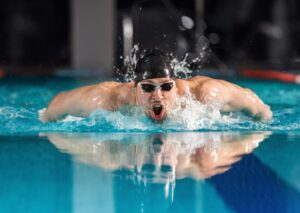
The butterfly is often considered the most demanding stroke. Arms and legs work simultaneously, requiring extremely precise timing.
One full cycle includes one complete arm stroke, two dolphin kicks, one inhale, and one exhale.From a streamlined position, the swimmer initiates the arm pull and the first dolphin kick at the same time. This action helps lift the chest and head for the breath. When the hands pass under the chest, the first kick is completed.
The second dolphin kick begins during the push phase of the arms toward the thighs. It supports the recovery phase of the arms over the water while the head returns underwater. Exhalation starts as soon as the hands re-enter the water, preparing for the next breath.
Efficient coordination reduces energy cost and helps maintain fluidity despite the high intensity of the stroke.- From a streamlined position, the swimmer initiates the arm pull and the first dolphin kick at the same time. This action helps lift the chest and head for the breath.
- When the hands pass under the chest, the first kick is completed.The second dolphin kick begins during the push phase of the arms toward the thighs. It supports the recovery phase of the arms over the water while the head returns underwater.
- Exhalation starts as soon as the hands re-enter the water, preparing for the next breath.
Coach’s drill: Swim butterfly using a single arm stroke paired with two clearly marked dolphin kicks per cycle.
🎯 Focus on the moment the head exits the water to inhale, then immediately return it underwater to exhale.
Backstroke coordination: finding the right rhythm
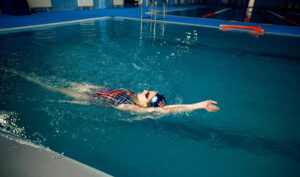
ackstroke has a key advantage: breathing is unrestricted since the face remains above water.
A full cycle includes one stroke of each arm, six kicks, two inhales, and two exhales. This continuous breathing pattern helps maintain a stable rhythm throughout the swim.
- The arms work in opposition at all times. When one arm pushes down toward the thigh, the other extends overhead. Each arm pull is supported by three dolphin kicks.
- Inhalation generally begins at the start of the pulling phase of one arm, while exhalation continues until the end of that push. The swimmer alternates breathing continuously without holding the breath.
Coach’s drill: Swim backstroke while mentally counting three kicks per arm cycle.
🎯 Link inhalation to one arm’s pull and exhalation to the other to automate breathing rhythm.
Breaststroke coordination: linking movements without interruption
Like butterfly, breaststroke is a simultaneous stroke. The arms work together first, followed by the legs.
A full cycle includes one arm movement, one leg kick, one inhale, and one exhale.
- From a streamlined position, the swimmer begins with the arm pull. This action lifts the head out of the water, allowing for inhalation. When the hands return under the chin, the leg kick is initiated.
- The breaststroke kick is typically broken down into three phases: bend, open, and snap together. Exhalation mainly occurs as the legs close and the swimmer returns to a streamlined position.
Coach’s drill: Swim lengths with a deliberate glide phase after each kick.
🎯 Focus on the sequence: arms → breath → kick → glide without rushing transitions.

Freestyle coordination: placing breathing at the right moment
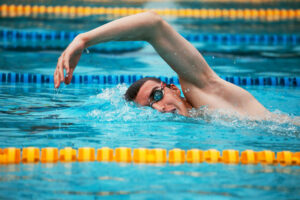
Freestyle is an alternating stroke whose coordination is similar to backstroke, but with a more complex breathing pattern. One full cycle includes one stroke per arm, two to six kicks depending on pace, one inhale, and one exhale.
- At middle-distance pace, one kick typically accompanies each arm stroke. In sprinting, swimmers often use six kicks per cycle (three per arm stroke).
Focus: breathing cycle
The main challenge is breathing timing. Exhalation must happen underwater before the head rotation. When air runs low, the swimmer turns the head to the side of the arm that has just completed its underwater pull to take a quick breath.
It is important to understand that it is impossible to effectively exhale and inhale at the same time while the head is rotated. Exhalation must therefore always be completed underwater in advance.
Depending on breathing frequency, swimmers may breathe on the same side every 2 or 4 strokes, or alternate sides every 3 or 5 strokes.
In open water, an additional factor comes into play: navigation. The swimmer briefly lifts the eyes forward every few breaths to check direction, then resumes normal breathing on the next cycle.
Coach’s drill: Swim freestyle focusing only on continuous underwater exhalation.
🎯 Turn the head only when the lungs are nearly empty, then inhale quickly before returning to a neutral position.
Coordination is the link between all technical elements in swimming. By properly synchronizing arms, legs, and breathing, swimmers improve efficiency while reducing energy cost. Each stroke has its own specific timing, but the principle remains the same: perform every action at the most effective moment. Once coordination is mastered, technical progress across all strokes becomes significantly easier.