




Kevin Audouy: “We knew it was going to be intense!”
We sat down with Kevin AUDOUY, a swimmer we know very well here at OpenSwim Harmonie Mutuelle. He has been participating in our events since 2017 and has even been one of our most loyal volunteers. After physical setbacks forced him to abandon his solo English Channel crossing attempt, he has just achieved the feat as part of a team, alongside Frédéric Taillandier, the event organizer. They conquered the Channel on January 19, marking the earliest crossing ever completed in a calendar year by swimmers wearing regular swimsuits in 7-degree water (7°C). We invite you to discover his firsthand account of this unique crossing.
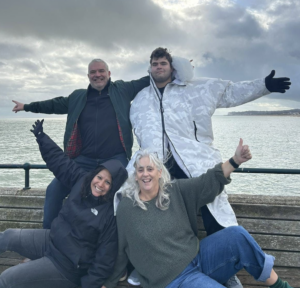
Hello Kevin, could you introduce yourself and tell us about your connection to swimming?
My name is Kevin Audouy, I am 30 years old, and I work as a trading floor salesman at a branch in Nantes. Originally, I was a pool swimmer, and then I transitioned to open water in 2017. I started with the Open Swim Stars and then participated in other organizations in parallel, such as those offered by the FFN (French Swimming Federation). Following a suggestion from open water swimming friends I met during the Open Swim Stars Paris editions, I joined the cold-water swimmers group, Les Ourcq Polaires, in October 2020, when pools closed due to COVID. They suggested I join them in the Canal de l’Ourcq so I could keep training through the fall and winter. This allowed me to adapt to temperatures of 14/15∘C in the autumn, which then dropped gently to reach 0 to 1∘C by February. From that point on, I developed a massive attraction to cold water, alongside pool swimming and regular open water during the rest of the year. This later led me to participate in cold-water and winter swimming competitions abroad, notably in Poland. When I moved to Nantes at the end of 2022, I joined a group that meets year-round on weekends to swim along the Atlantic coast. Finally, before succeeding in this team crossing in the dead of winter, I made a solo attempt to cross the English Channel in July 2024, which I unfortunately did not finish due to shoulder issues that arose during the swim.
What was the reason for your abandonment?
They pulled me out of the water just a few kilometers before the end, even though I thought I felt fine. In the end, when I got onto the boat, both of my arms and shoulders were completely locked up. It took numerous physical therapy sessions afterward to regain full mobility.
I assume it was when you arrived in Nantes that you met Frédéric Taillandier, the organizer of this team crossing?
Exactly. I met Frédéric through my swim club, thanks to swimmers who swam in open water along the coast all year round. I started swimming with him in the summer or autumn of 2022, and since then, we swim together every weekend of the year—whether in the sea, the river, or a lake.
Where do you usually go swimming on the coast?
Mostly in Pornic. It’s the easiest and closest place to Nantes. There is an enclosed seawater basin that refills from time to time. Aside from that, we can swim along the coastline. We sometimes do long swims, especially in the summer, ranging from 10 to 12 kilometers. And we regularly do shorter or longer outings. It mostly depends on the tidal coefficients and the athletic, physical, and mental capacities of the other swimmers. Or, quite simply, depending on what we feel like doing. But most of the time, we take the opportunity to stay in the water for 2 to 3 hours. It’s definitely better than being shut inside a pool, right?
Let’s talk about this beautiful achievement: becoming the first team to successfully complete the earliest English Channel crossing of the year. How did you find yourself onboard this adventure?
Well, it stems from two things. First, Frédéric and I had already been talking about it for quite a while. He had attempted a solo Channel crossing a few years ago and didn’t finish. I had attempted it as well without finishing. So, naturally, we had a score to settle. However, the format still needed to be defined. Since we are cold-water swimmers and we truly love it, we thought: why not try to combine the two—cold-water swimming and open water distance swimming?
After a year of thinking it over, we decided we needed to do a relay in the dead of winter. But with just the two of us, we knew we wouldn’t have enough time to recover between each rotation, especially in terms of body temperature. Later on, I discovered that other swimmers had already attempted an English Channel relay crossing (5 men succeeded, and 5 women also attempted but were forced to give up ) during the winter of 2024. That was the spark. We told ourselves it could be a beautiful story to tell if we could cross the Channel together as a team. Originally, we hadn’t set out to do a mixed 4-person relay, notably because we found the final team members quite late after several roster changes up until two months before the departure. In the end, two female swimmers joined the adventure: Makala Jones from Wales, who came highly recommended, and Arleen Gonzalez from Mexico, whom I had met at an Ice Mile in Morocco a few years back and had stayed in touch with. They are two formidable swimmers with extensive experience in long-distance cold-water swimming, and they joined us in our challenge.
How was your request to cross the Channel received by the boat pilots, given it was an unusual season for them?
First of all, we faced some rejections because we submitted our request a bit too late. Ultimately, Frédéric, through his direct discussions with the pilots and his contacts in England, managed to convince them by proving that we all had genuine cold-water experience. Thanks to that, we managed to secure this slot in January, despite knowing that conditions would be complicated at this time of year.
Once you obtained the authorization, how did you prepare?
Well, Fred and I continued doing our ocean swims. Makala was also swimming a lot on her side in the sea. As for Arleen, she was training in an unheated, very cold pool. Then, we organized a team training camp in mid-December with Makala. We completed a round-trip swim between Noirmoutier and Pornic—in regular swimsuits, of course—to try to replicate the conditions we would face in January. The water temperature was around 9∘C, and the distance was 30 km. We did it using a rotation of 1 hour of swimming and 2 hours of recovery. It served as our benchmark test. On the support boat, we also had the 3-person crew that would follow us during the actual crossing: the doctor and 2 support crew members handling monitoring and nutrition. This allowed us to test our setup and reassured us of our ability to complete the crossing.
And now, we are on the morning of January 19. How did the crossing go?
Stepping onto the boat, we told ourselves, “We knew it was going to be intense!” Especially regarding the water temperature and the strong currents we were bound to encounter at the finish. So, naturally, there was some apprehension. On top of that, a cold wave had hit France and England in the preceding days. The water temperature was 7∘C, which naturally heightened our anxiety. But above all, there was a lot of excitement at the start, knowing we were finally going to swim. Even though I was prepared, I was afraid of failing. Afraid of not being up to par for this relay, and that things would go wrong because of me—even though I know what I’m capable of. I asked myself a lot of questions before the start because it was quite a significant and intimidating project. And we had never trained in water and air temperatures that cold. On my end, there was certainly some uncertainty, but I was convinced that as a team, we were going to give it everything to succeed.
And you’re off. What was your position in the team, and how did you choose the rotation order?
The choice was made very simply; the four of us discussed it the night before to figure out who would start, and particularly to determine who might risk having to swim one more rotation than the others. We let our two female swimmers speak first. Arleen immediately said, “I want to go first.” Makala ended up going 2nd Frédéric third, and I went fourth.
Once the relay order was established, how did you experience your swim up until the arrival on the beach?
My memories are still very vivid. So, Arleen went first. Seeing her get ready and jump into the water to reach the starting beach reminded me of when I did it for my solo swim back in the day. She starts, and the team knows it’s officially on and that our time is coming. We started experiencing a lot of swell. Honestly, having done it as a swimmer but never as a passenger on a support boat, realizing the strength of the counter-current and the heavy swell right from the very first swim makes you think, “If it’s starting like this, what is it going to be like later?” It turned out she didn’t back down and gave everything to deliver a magnificent first swim. After that, it kept moving—Makala, then Fred. Each time, everyone swam at their own pace, maintaining good speed. And then it was my turn. I was just eager to swim, to do my part like the others. It was pure joy during my hour of swimming. It went by very quickly with the team’s encouragement. I didn’t feel like I was swimming alone. However, after my first exit from the water and my first “rewarming” session, things didn’t go very well for me. You have to understand that the air temperature was much colder than the water, and to warm up and refuel, we had to go inside the boat’s cabin. What was bound to happen happened: I got severe seasickness.
You had to go back outside, I assume?
Indeed, I had to get back outside quickly. As a result, all of my subsequent rewarming sessions had to take place out on the deck of the boat, in the chilly fresh air.
The total swim time was 16 hours and 27 minutes, which meant 4 rotations for you. What was your most difficult rotation?
I did indeed go in 4 times, and Arleen stepped into the water a 5th time for her part. For those on the boat, my third rotation looked the worst because they thought I was completely disoriented. Night was falling, and since the lights on the boat hadn’t been properly turned on, I couldn’t see it turning very well. So I was accelerating, slowing down, trying to follow the rhythm as best as I could. On the boat and pilot’s side, they almost stopped me because they thought I was lost. That is where the role of the support crew was decisive. They informed the pilot that they knew me well and believed I just couldn’t see the boat turning properly. So they gave me a chance during my final 10 minutes of swimming before I exited the water. They saw me climb back onto the boat unassisted and saw that I recovered very well. But for me personally, the worst rotation was the 4th. It was dark, we could see the French coast lit up, we caught glimpses of the lighthouse from time to time, we could see the potential arrival beach, and I told myself there was a high risk we wouldn’t finish due to a powerful counter-current and swells that were tossing you and the boat in every direction. The famous swimmer’s graveyard! And because it was dark, and I was really close to the boat, there were moments when I couldn’t even see the beach in front of me anymore. Not to mention that I must have swallowed water 15 or 20 times during that hour. But I kept telling myself: “I have to keep going no matter what.” To do that, I stopped accelerating and slowing down like I did during my previous run, because I had been told there was a risk the pilot would pull me out. So I swam at full throttle and didn’t stop despite my shoulders becoming painful and the swell pushing me toward the boat. It was cleanly and clearly grueling.
You must have been overjoyed to finish?
Holding out for that hour despite the terrible conditions was a massive relief. Especially when they started making little cheers of joy right before I exited the water. That was the signal we had set up between us to warn the next swimmer two minutes before the transition. And indeed, when I heard that signal, I was relieved in one sense, but disappointed not to have landed on the beach as initially planned. I can say today that it was the worst hour of swimming of my life, whether in a pool or anywhere else. But at the same time, it was the best swim of my entire life, because I knew I had truly given it everything, that I had never given up.
After Arleen arrived on the beach, how did you experience this collective success, and how would you summarize your adventure?
Just an incredible moment, a superb swim. We gave it our all, we were in the cold, it was hard, but we were together, among swimmers. We knew everyone was going to give their maximum effort, and we knew that our team and our everyday friends were right behind us. When we were swimming, we knew they were right there on the boat with us. They were kind of like our guardian angels. It was extraordinary.
One last question, do you have other projects for the future?
Yes, we do. We are actually thinking about doing other winter swims. This is a project we’ve already discussed together. And inevitably, attempting a solo English Channel crossing again one day, probably in a year and a half to two years.
Interview conducted by Laurent NEUVILLE on April 3, 2026.