




The history of swimming is far older than we imagine. While learning to swim is now considered an essential skill, this practice has undergone profound changes over millennia. Between climate shifts, exchanges between civilizations, and social inequalities, discover how the relationship between humans and water was built and why knowing how to swim has never been a given for everyone.
Inspired by the work of Karen Eva Carr in A World History of Swimming.
Why did humans forget how to swim?
For millennia, knowing how to swim was a skill widely shared by humans. Yet even today, billions of people have not mastered swimming. How can we explain this paradox?
In her book A World History of Swimming, historian Karen Eva CarrKaren Eva Carr traces the evolution of humanity’s relationship with water: from the first prehistoric swimmers to modern societies where swimming remains unequally accessible.
When climate made us forget how to swim
Modern humans left Africa approximately 42,000 years ago, already knowing how to swim. But a major cold wave, occurring around 33,000 BCE, profoundly altered this relationship with water.
Across much of Europe and northern Asia, temperatures became so low that swimming gradually disappeared from daily practices. Over generations, communities lost this cultural habit. Water then became a place of danger rather than a space for leisure or travel.
Conversely, populations living in warmer regions continued to swim and pass on swimming knowledge. A divide thus formed between swimming societies and non-swimming societies.
The first evidence of swimmers
When they left Africa 42,000 years ago, modern humans knew how to swim, but a massive cold wave around 33,000 years ago changed how many people across the world approached swimming. During the last ice age, throughout northern Asia (in Japan, Korea, northern China) and Europe, everyone seems to have forgotten how to swim. “It simply wasn’t warm enough anymore, even in summer, for people to want to swim,” explains Karen Eva Carr. As a result, human communities in the northern regions of the globe lost the cultural habit of swimming.
Swimming came to mean drowning, so bodies of water became places of danger, populated by mythical creatures like dragons and sea monsters. People in warmer regions continued to swim, creating a global divide between those who could swim and those who could not. But when the climate improved and people moved around the planet, things changed.
The earliest evidence indicates that swimming was practiced well before our era:
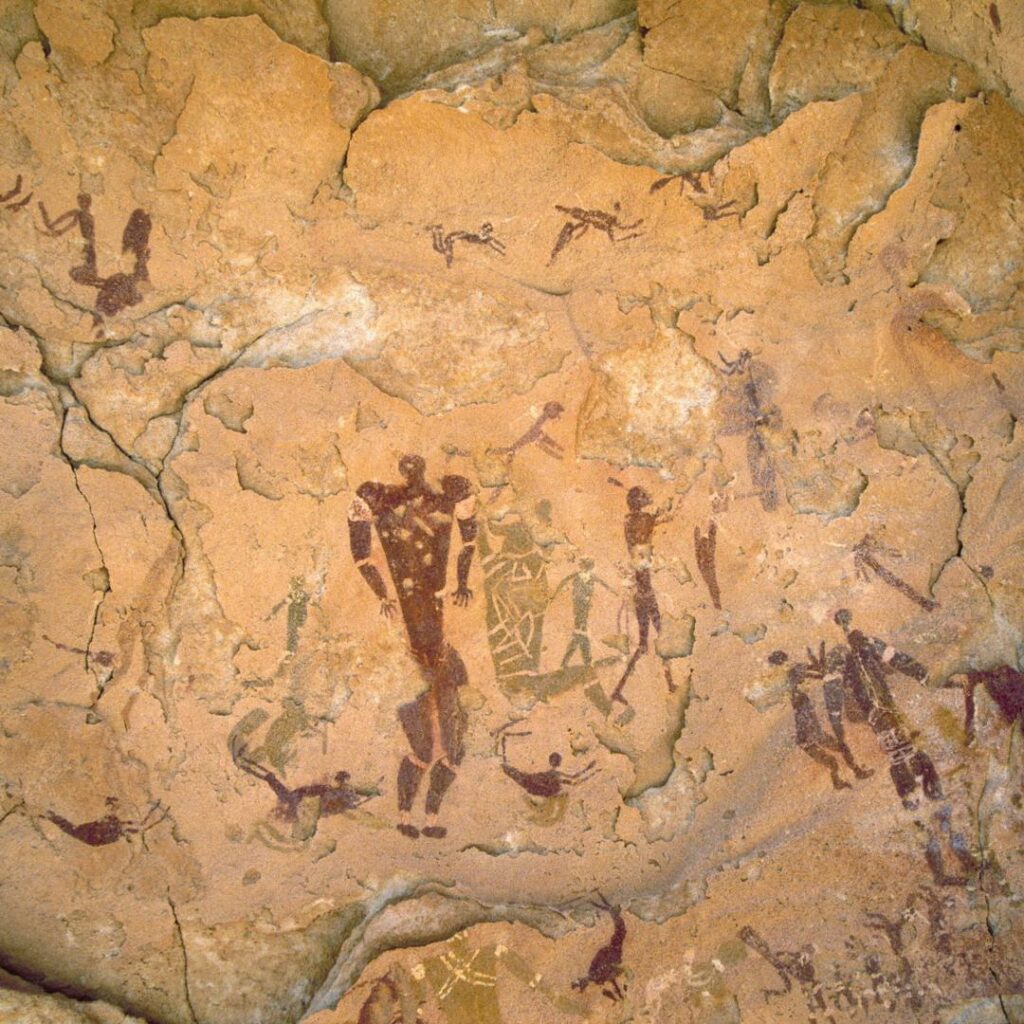
In 1933, “the Cave of Swimmers” was discovered, a rock art site located on the Gilf al-Kabir plateau in the Libyan Desert, Egypt. The cave paintings were probably created in the early Neolithic period, around the 9th millennium BCE. Then, around 2,900 BCE, images and writings prove that the ancient Egyptians, in a region far from the once-cold northern zone, were great swimmers.
“They have good form. They use a nice arm stroke. They really seem to know what they’re doing,” explains Karen Eva Carr.
In tomb carvings, a powerful governor named Kheti boasts of having taken swimming lessons as a child with the pharaoh’s children. Wealthy Egyptians were not the only ones swimming: there is evidence that people of all social classes, all along the Nile, learned to swim. Karen Eva Carr cites numerous stories that prove this, including an ancient Ethiopian story in which a future husband must show courage by swimming to an island, spending the night there, then swimming back. If he succeeds, he earns the right to marry his lover.
Learning from other peoples
Around 700 BCE, Europeans, Assyrians, and other groups began trading more with Egypt.
“They are all impressed by the sophistication of the Egyptians… All these northern people start using Egyptian papyrus for writing, eating dates, wearing glass beads and linen robes of Egyptian origin; and start learning to swim to show how sophisticated they are,” explains Karen Eva Carr.
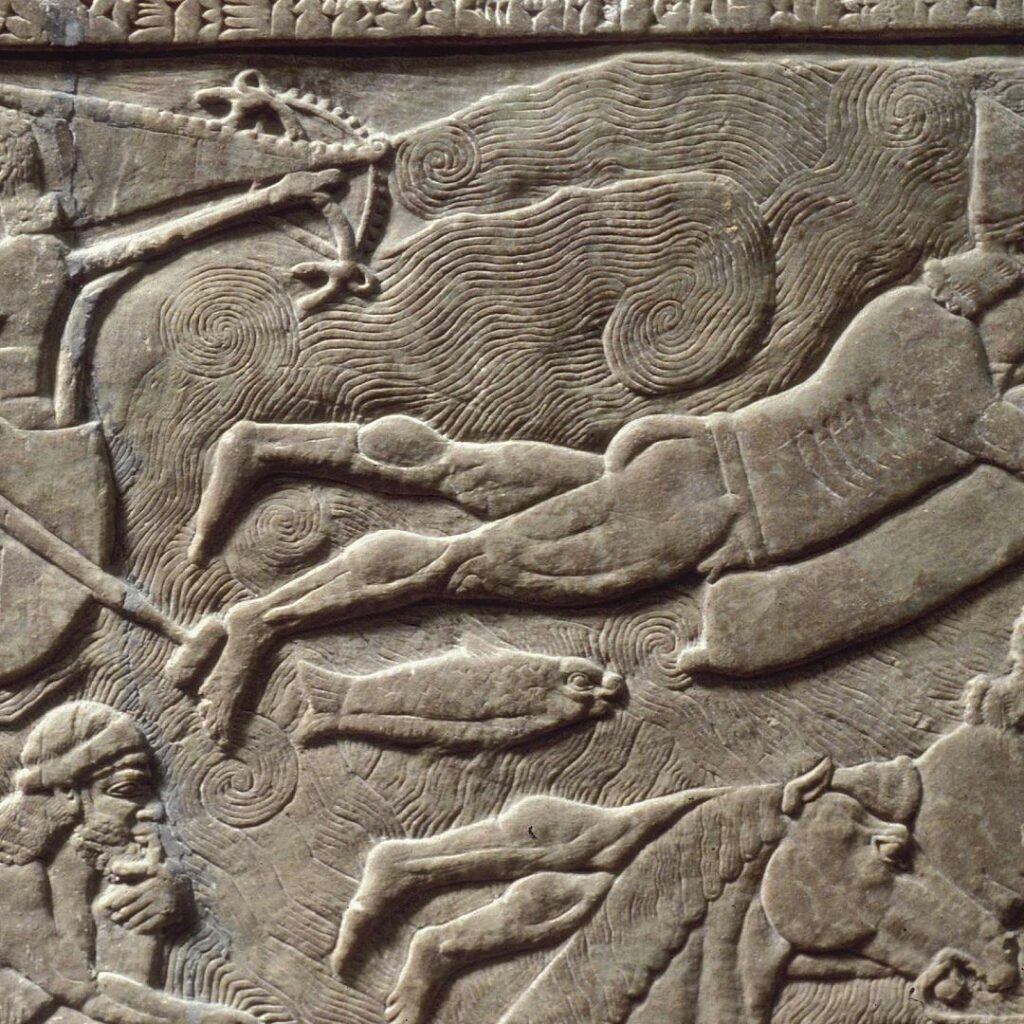
As swimming spread, traces of what may have been the world’s first flotation device appear: Assyrians using an inflated goatskin.
Right: Assyrian soldiers crossing a river by swimming with goatskin flotation devices, into which they must constantly blow to stay afloat.
People in northern Asia had also stopped learning to swim during the last ice age, but this changed when they came into contact with southern populations.
“Just as people swam in ancient Egypt, but not farther north in Europe and western Asia, they also swam in Southeast Asia and Indonesia, but not farther north in northern China or Japan.”
Thus, non-swimmers in northern China and Japan learned from swimmers in southern China in the same way that Europeans learned from Egyptians.
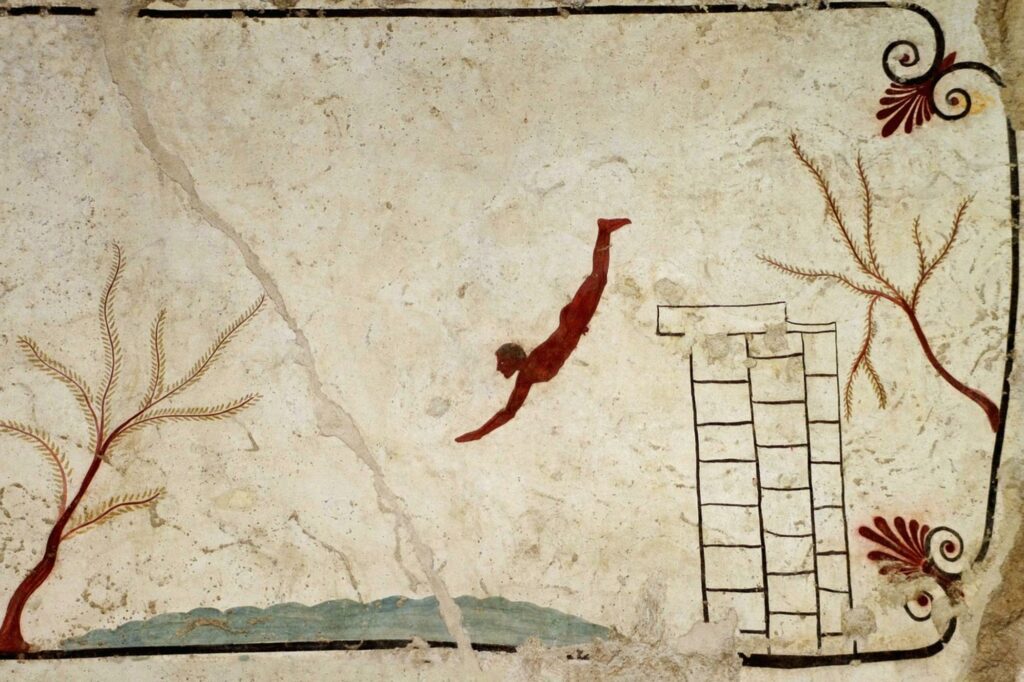
Right: A man jumping into water from an elevated platform. Ancient painting about 2,500 years old from the Tomb of the Diver in Paestum, Italy.
A pastime for the wealthy
In Europe, as more people learned to swim, a class divide emerged. Swimming became the exclusive domain of the wealthy.
“In Europe, people associated swimming with being rich. So it was something only the wealthy were supposed to do, like wearing fine clothes or eating refined dishes.”
And according to a quote from the Greek philosopher Plato, “An uneducated person can neither read nor swim.” And over the years, it was a very specific type of swimming that the wealthy engaged in, and “if they swim, they only swim breaststroke to show that they are civilized people who don’t splash,” explains Karen Eva Carr.
Dehumanization and exploitation
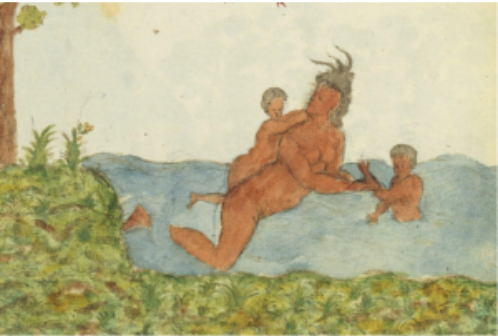
During the age of exploration, European powers sailed the world. But many on these ships did not know how to swim. For example, “neither Captain Cook nor his crew knew how to swim, and they were all nervous around water.” This is why they were amazed by the swimming abilities of those they encountered in the Pacific.
Right: A 1586 depiction of Arawak or Carib swimmers near Trinidad. (Natural History of the Indies: The Drake Manuscript, Pierpont Morgan Library).
Racist laws
As swimming became a popular pastime in many countries, the racial divides surrounding it became law:
“There was a global trend to exclude Black and brown people from swimming areas.” “This started in South Africa, where the first beaches were segregated around 1888, and it spread from there, around the world.”
The idea was that “water is reserved for civilized white swimmers.”
Swimming today
Despite the popularity of modern swimming, learning remains far from universal. According to a large international survey cited by Karen Eva Carr, more than half of adults worldwide would not know how to swim without assistance.
Several factors explain this situation:
- limited access to pools
- the cost of lessons
- lack of supervision
- fear of water passed down through generations
- pollution or absence of safe swimming areas
- persistent social inequalities
For Karen Eva Carr, history continues to weigh on the present: societies that lost the culture of swimming millennia ago have sometimes transmitted, consciously or not, a lasting distrust of water.
To conclude
The global history of swimming shows that knowing how to swim is not just a physical skill. It is also a cultural, social, and historical practice.
For tens of thousands of years, humanity has alternately learned, forgotten, and relearned how to swim. Understanding this history reminds us that access to swimming has never been equal for everyone, and that teaching people to swim remains a major issue of public health, safety, and equality today.