




Breathing is one of the most important skills in swimming, yet it is often one of the most overlooked. Many beginner and intermediate swimmers become out of breath long before their fitness becomes the limiting factor. In most cases, the problem isn’t cardiovascular fitness—it’s poor breathing technique.
Learning how to breathe efficiently allows you to swim farther, stay relaxed, and maintain better technique throughout your workout.
Understanding Swimming Breathing
Unlike breathing on land, breathing in the water is not automatic. Our natural instinct is to hold our breath when submerged because the brain perceives water as a potentially hostile environment. To swim comfortably, you must override this reflex and learn to exhale continuously so that inhaling becomes quick and effortless.
Breathing also varies from one stroke to another. Body position, stroke rhythm, and the moments when your face clears the water all influence how you breathe. However, several principles apply to every stroke:
- Exhale primarily through your mouth.
- Never hold your breath.
- Keep your cheeks relaxed rather than puffing them out.
- Establish a consistent breathing rhythm from the beginning of your swim.
One fundamental rule applies to every swimmer: When you feel out of breath, the problem usually isn’t a lack of oxygen—it’s too much stale air trapped in your lungs. A complete exhalation creates room for a full inhalation, delivering more oxygen to your muscles.
Stroke-by-Stroke Breathing Guide
Butterfly Breathing Technique
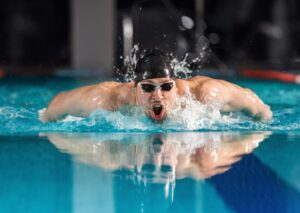
Butterfly requires excellent coordination between the arm stroke and head movement. Because butterfly is highly demanding physically, efficient breathing is essential.
- Inhale while your head rises naturally during the recovery phase, typically every one or two arm cycles. Keep your mouth as close to the water as possible. Lifting your head too high increases drag and quickly leads to fatigue.
- Begin exhaling as soon as your hands re-enter the water. Continue breathing out steadily through the underwater pull. When your mouth clears the surface again, take a quick, efficient breath.
During underwater dolphin kicks after starts and turns, maintain a steady exhalation throughout the underwater phase.
Proper butterfly breathing helps conserve energy, maintain rhythm, and significantly increase the distance you can swim comfortably.
Coach’s Drill: swim butterfly using only your arms (option: place a pull buoy between your legs).
🎯 Focus exclusively on how high you lift your head. Your chin should barely skim the water’s surface when breathing. The goal is to avoid excessive head lift that disrupts body alignment.
Backstroke Breathing Technique
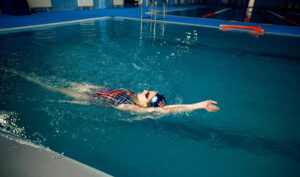
Backstroke offers one major advantage: your mouth and nose remain above the water throughout the stroke. This makes breathing much more natural.
- Inhale through your mouth.
- Many swimmers naturally exhale during the finishing phase of each arm pull as the hand travels from the hip toward the thigh.
Because the flutter kick works continuously, maintaining regular breathing is essential to avoid unnecessary fatigue.
During underwater backstroke streamlines, gently exhale through your nose to prevent water from entering your nostrils. Some swimmers also choose to wear a nose clip. Take a full breath as soon as you surface.
Coach’s Drill: push off the wall on your back with your arms by your sides.
🎯 Exhale slowly through your nose during the entire glide. Only inhale once your lungs feel nearly empty.
This drill helps eliminate the instinct to hold your breath and promotes a relaxed breathing rhythm.
Breaststroke Breathing Technique
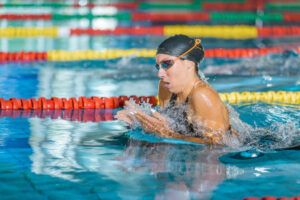
Breaststroke breathing follows a simple but precise sequence that coordinates the arms, legs, and head.
- Always inhale through your mouth when your head rotates naturally with your body roll.
- Begin exhaling as soon as your face returns to the water.
The ideal time to exhale is during the leg recovery and throughout the glide phase, allowing you to empty your lungs gradually before the next stroke. The same principle applies after starts and turns.
During the underwater phase, exhale steadily before taking your next breath as you surface.
Coach’s Drill: swim breaststroke while deliberately extending the glide after every kick.
🎯Focus on breathing calmly during the glide instead of rushing to the next stroke. This exercise helps develop a relaxed, efficient breathing rhythm.
Freestyle Breathing Technique
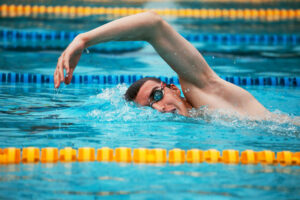
Freestyle breathing is often the biggest challenge for swimmers, but mastering a few key principles makes a huge difference.
- Always inhale through your mouth when your head rotates naturally with your body roll.
- Begin exhaling as soon as your face returns to the water.
Your head should remain aligned with your spine throughout the stroke. When breathing, rotate your head with your shoulders rather than lifting it independently. Your eyes should look roughly 90 degrees to the side—not behind you. Looking backward disrupts your balance, lowers your hips, and reduces kicking efficiency.
Coach’s Drill: swim with one arm extended in front while the other remains at your side. Practice rotating your head naturally with your shoulder roll to breathe.
🎯 This drill teaches you that your head follows the body’s rotation rather than initiating the movement.
Efficient breathing is a fundamental swimming skill that improves every stroke. Whether you’re swimming butterfly, backstroke, breaststroke, or freestyle, the principle remains the same: Exhale continuously so you can inhale quickly and efficiently. Mastering your breathing technique reduces fatigue, improves endurance, and allows you to swim farther with greater comfort and confidence.