




The Swimmer’s Guide to Nutrition by Alistair Brownlee
PART 1: The Fundamentals
Fueling Your Swim & What the Science Says
Swimmers have a fairly basic nutrition problem: it is awkward to eat in the water. On a bike, you can reach for a bottle or a gel without stopping. In the pool, everything is sitting at the end of the lane, and the coach, or the clock, is normally counting down the seconds until you have to go again. In open water, it is even more complicated.
That inconvenience can push people towards two extremes. Some swimmers do every session on water alone because it is “only swimming”. Others add carbohydrates and electrolytes to every bottle, even for an easy technique session.
I must admit, for most of my career I was closer to the first group. I hardly ate or drank anything during swim training. However, I had the luxury of being able to fuel and rest afterwards. It is a luxury I do not have now, when I am normally rushing from the pool to my next meeting or the email inbox.
Fuel the work required
A relaxed 45-minute technique session and a hard 90-minute mixed set are metabolically very different. They are not the same nutritional problem.
Most swim training is not one steady effort. A session might contain an easy warm-up, drills, threshold work, sprints and a pull set. Even if the average pace does not look particularly demanding, the harder parts rely heavily on carbohydrate.
Your body stores carbohydrate as glycogen in the muscles and liver. Those stores are limited. Arriving well fuelled helps you hold speed and maintain your technique through repeated efforts. Arriving underfuelled often shows up as poor-quality swimming late in the set, rather than a dramatic “bonk”. [1]
💡 What science says
In a classic study, 12 highly trained swimmers increased their daily swimming distance from approximately 4.3 km to 9.0 km for 10 days. Four of the swimmers could not maintain the required training speeds. Those swimmers had lower muscle-glycogen concentrations associated with unusually low carbohydrate intake.
It is a small and fairly old study, but it makes a useful practical point: high-volume, high-intensity swimming can outrun the amount of carbohydrate you are putting back. [2]
That does not give us a neat figure for “grams of carbohydrate burned per hour”. As the intensity changes from aerobic swimming to threshold work and short anaerobic efforts, fuel use changes as well. It also varies with pace, stroke, efficiency, body size and the amount of recovery between efforts.
The evidence supports protecting carbohydrate availability for important sessions. It does not support pretending that every swimmer uses the same amount each hour.
Nor does it mean that every swimmer needs a gel in every session. The duration and intensity of the session, what you ate beforehand and what training you have coming next should determine the plan. The sensible aim is enough carbohydrate for the work.
How to fuel before and during your session?
If you are swimming later in the day, a normal carbohydrate-based meal two to three hours beforehand will cover a lot of sessions. Oats, rice, bread, cereal, fruit and potatoes are all fine. Keep it familiar. A hard swim is not an excuse for an enormous meal that is still sitting in your stomach when you dive in.
Early-morning swimming is where people often struggle. You may not want breakfast at 5.30 am. Or, if you are like I was, you want to maximise your time in bed and do not leave yourself enough time to eat before rushing out of the door. Going from an overnight fast straight into threshold or sprint work can make it harder to maintain the quality of the session. A small amount of easily digested carbohydrate, roughly 20–40 g, shortly before swimming can bridge that gap. A banana, toast or one 40 g gel with water can all work.
If the session is easy and you ate well the night before, you may be perfectly comfortable waiting until afterwards. If it is a key quality session, I would rather put some fuel in than spend the final third practising how to swim slowly.
These are useful starting points, not numbers you have to hit at all costs. [1,3]
Under 60 minutes, easy or technical
→ Water is normally enough if you start fed and hydrated.
→ An electrolyte drink can be useful if the pool hall is warm, you know you lose a lot of salt, or the swim is one part of a longer training day. There is generally little reason to force carbohydrate into an easy session of this length.
60–90 minutes, mixed or high intensity
→ Aim for approximately 40–60 g of carbohydrate per hour.
→ This is particularly useful for early-morning sessions, demanding main sets or when you have eaten very little beforehand.
→ In practical terms, that could mean one 40 g gel during a hard 60-minute session or two gels spread across a demanding 90-minute session. You can take the gel separately with water or mix it into your bottle and sip it during the session.
Over 90 minutes, hard, or part of a heavy training day
→ Aim for approximately 60–80 g of carbohydrate per hour.
→ For simplicity, 80 g per hour is two truefuels gels. The upper end is for genuinely demanding work and is not the default for every long swim.
→ Your salt choice should reflect the conditions and your own sweat losses. Do not automatically choose the highest-salt option simply because the session is long.
What does the swimming research show?
The swimming-specific evidence is small and the results are mixed.
In one study eight elite open-water swimmers completed three 30-minute blocks in a swimming flume at their expected 10 km race pace. They consumed 45 g of carbohydrate after 30 minutes and another 45 g after 60 minutes, equivalent to an average of 60 g per hour over the 90-minute swim.
After those 90 minutes, they completed a high-intensity swim to exhaustion. The swimmers lasted an average of 169 seconds in the carbohydrate trial compared with 102 seconds with the placebo. [4]
That does not mean carbohydrate made the swimmers 65% faster over 10 km. It means carbohydrate appeared to protect their capacity for a hard effort at the end of a prolonged swim.
These are two small studies with different protocols and different outcomes. They do not give us a definitive “perfect” intake for open-water swimming. They do support the practical idea that carbohydrate may become particularly valuable when a long race contains changes in pace, attacks or a hard finish.
Why use more than one type of carbohydrate?
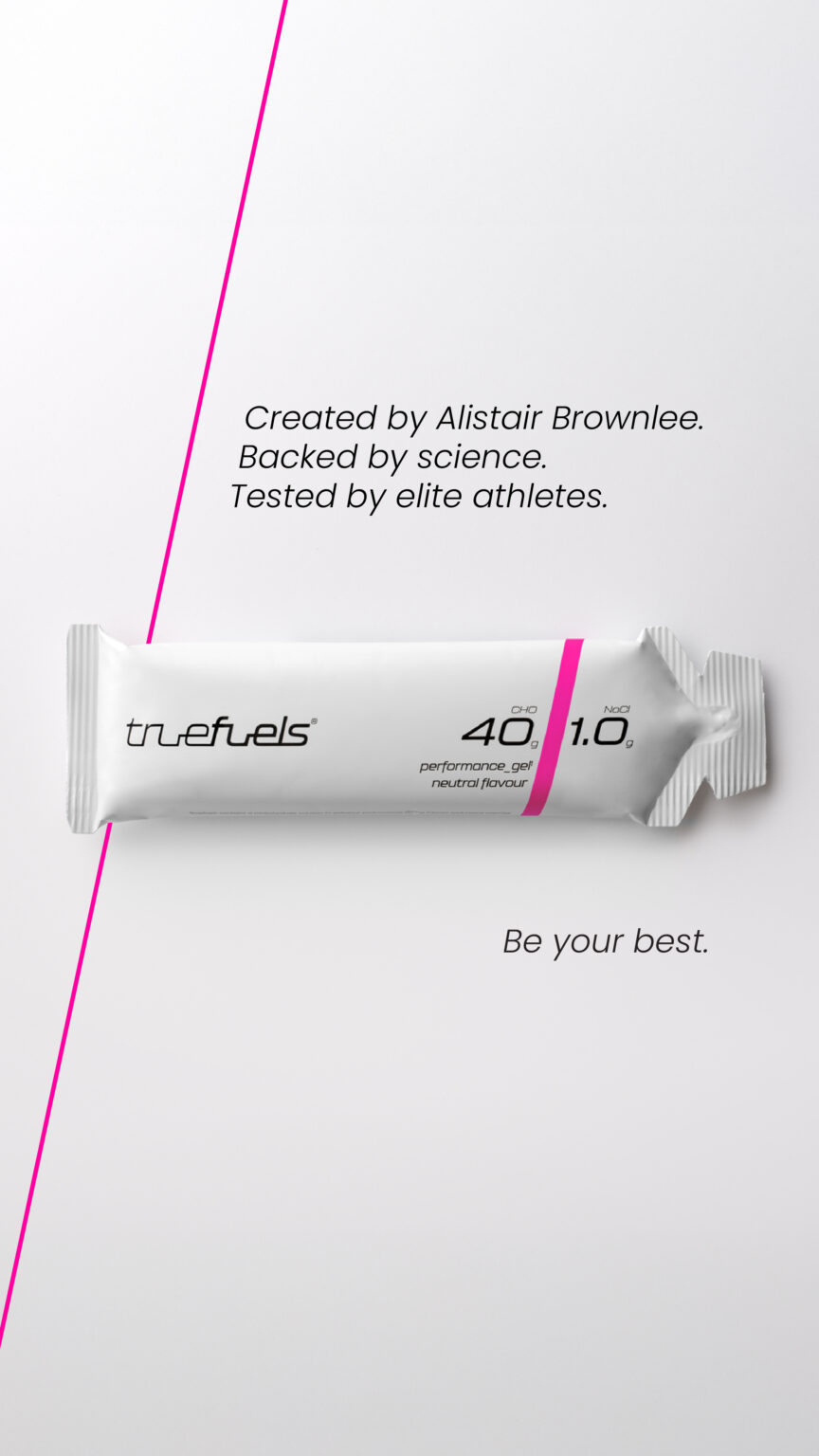
The truefuels gel uses a 1:1 maltodextrin-to-fructose blend.
Maltodextrin is broken down into glucose, while fructose is absorbed through a partly separate intestinal transport pathway. Combining the two can increase total carbohydrate absorption compared with relying on a large amount of glucose alone, particularly at higher intakes. [1]
Each gel contains 40 g of carbohydrate, which makes the arithmetic straightforward:
- One gel per hour provides 40 g.
- Two gels per hour provide 80 g.
- Three gels per hour provide 120 g.
That does not mean three is always better than two. It means you can build a measurable plan and adjust it according to the demands of the event.
[1] Burke LM, Hawley JA, Wong SHS, Jeukendrup AE. Carbohydrates for training and competition. Journal of Sports Sciences. 2011;29(Suppl 1):S17–S27. https://doi.org/10.1080/02640414.2011.585473
[2] Shaw G, Koivisto A, Gerrard D, Burke LM. Nutrition considerations for open-water swimming. International Journal of Sport Nutrition and Exercise Metabolism. 2014;24(4):373–381. https://doi.org/10.1123/ijsnem.2014-0018
[3] Baldassarre R, Sacchetti M, Patrizio F, et al. Carbohydrate supplementation does not improve 10 km swimming intermittent training. Sports. 2018;6(4):147. https://doi.org/10.3390/sports6040147
[4] Baldassarre R, Ieno C, Bonifazi M, et al. Carbohydrate supplementation during a simulated 10-km open-water swimming race: effects on physiological, perceptual parameters and performance. European Journal of Sport Science. 2022;22(3):390–398. https://doi.org/10.1080/17461391.2021.1880644