




Core strength is one of the foundations of efficient swimming. Whether you’re a beginner, a recreational swimmer, or a competitive athlete, a strong and stable core directly affects your speed, stroke efficiency, and ability to maintain good technique as fatigue sets in.
Why Core Strength Matters in Swimming
Long before the term core training became popular, swimming educators had already recognized its importance. In his landmark book The Teaching of Swimming, French coach Raymond Catteau introduced the concept of the “projectile body.”
The idea is simple: a swimmer should move through the water like a streamlined projectile, encountering as little resistance as possible.
Core strength isn’t about constantly contracting every muscle. Instead, it means maintaining enough stability through the trunk to efficiently transfer the forces generated by the arms and legs.
A swimmer with a stable core minimizes unnecessary movement, improves hydrodynamics, and uses less energy to maintain the same speed. In other words, a strong core is one of the keys to swimming farther and faster with less effort.
Why Every Swimmer Needs a Strong Core
Water is an unstable environment with no fixed support. Every stroke generates forces that can disturb your body alignment. If your trunk lacks stability, part of the energy produced by your arms and legs is lost through unnecessary body movement.
Developing core strength allows you to:
- Maintain better body alignment.
- Reduce drag.
- Transfer propulsive force more efficiently.
- Improve coordination.
- Stay relaxed while swimming.
- Maintain good technique even when fatigued.
- Improve performance in every stroke.
Build Your Core on Dry Land
Although core stability is expressed in the water, it is often developed through dryland training. Strengthening the deep muscles that stabilize the trunk, pelvis, and shoulders creates a stronger foundation for efficient swimming.
Some of the most effective exercises include: Front plank, Side plank, Dynamic plank variations, Hollow hold, Bird-dog, Single-leg stability exercises
These movements improve trunk stability while enhancing body awareness and control.
Stroke-by-Stroke Guide
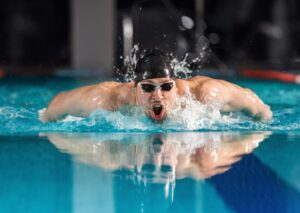
Butterfly: Transferring Power Through the Body
Butterfly is probably the stroke where core strength is most visible. Efficient butterfly relies on transmitting force smoothly from the upper body to the lower body.
- Improve Your Dolphin Kick: contrary to popular belief, the dolphin kick doesn't begin in the legs—it originates in the trunk. The more effectively your core transfers this movement, the more powerful and efficient your propulsion becomes.
- Make Breathing Easier: a stable body allows the chest to rise naturally for each breath without disrupting body position.
Strong core stability also limits unnecessary side-to-side movement and prevents excessive head lift during breathing, reducing drag.
🔍 One of the greatest benefits of core strength is maintaining efficient technique as fatigue increases. Swimmers with stronger cores typically preserve stroke length and efficiency for much longer.
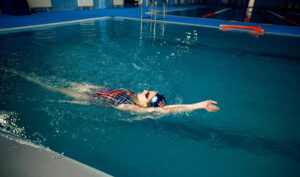
Backstroke: Maintaining a Stable Body Line
Backstroke demands excellent body stability.
The propulsion generated by the arms and legs must be transmitted through the body without excessive movement.
Core strength helps maintain the projectile body position, minimizing frontal resistance and improving efficiency.
- A stable trunk also enhances the effectiveness of the flutter kick by directing force backward rather than allowing it to dissipate sideways.
- The hips benefit particularly from improved stability. Weak core muscles often cause unnecessary lateral movement that slows the swimmer. A stable pelvis promotes a smoother, faster stroke.
🔍 Core stability also allows the shoulders to remain relaxed during the arm recovery while making breathing feel more natural.
Breaststroke: Improving Coordination Through Stability
Breaststroke requires exceptionally precise coordination between the arms, legs, and breathing.
Core strength plays a vital role in maintaining this coordination.
A stable trunk keeps the body aligned throughout the stroke cycle, reducing wasted energy.
- Better Coordination: a strong core improves the timing between each phase of the stroke, making movement smoother and more efficient.
- Easier Breathing: core stability helps lift the chest during breathing without excessively disrupting body alignment. As a result, you preserve more of the speed gained during the glide.
- Greater Relaxation: a stable body also allows unnecessary muscular tension to disappear, making your stroke feel smoother and more consistent.
🔍 Finally, improved core stability minimizes unwanted side-to-side movement during both the arm pull and the whip kick, helping you swim in a straighter, more economical line.

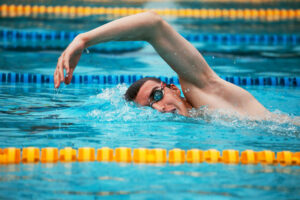
Freestyle: Why Core Strength Is Essential
In freestyle, core strength influences nearly every aspect of performance.
- Better Body Position: the more streamlined your body remains, the less frontal and friction drag you create.
- More Efficient Rotation: a stable core makes body roll and breathing smoother while helping maintain balance throughout the stroke.
- Longer Stroke Length: greater stability allows your arms to extend farther forward without disrupting your overall body position.
- A Stronger Catch: core stability improves your catch by allowing the force generated by your pulling arm to transfer efficiently through your entire body, increasing propulsion.
-
Less Wasted Movement: perhaps most importantly, a stable trunk prevents unnecessary rocking and side-to-side movement.
Instead of losing energy through body oscillation, more of your effort is directed forward.
🔍 One of the hallmarks of elite freestyle swimmers is their ability to combine exceptional stability with complete relaxation. This balance between strength and looseness is a key ingredient of efficient freestyle.
Core strength is far more than simply holding a plank on the pool deck. It is one of the fundamental physical qualities that determines your body position, hydrodynamics, propulsion, and technical efficiency in the water.
Whether you swim butterfly, backstroke, breaststroke, or freestyle, improving your core strength will help you transfer force more effectively, reduce drag, and maintain efficient technique for longer.