




Body position is one of the most important yet overlooked aspects of swimming. Many swimmers focus on propulsion or breathing without realizing that maintaining a stable position in the water is the foundation of efficient technique. A well-balanced body reduces drag, improves coordination, and allows every movement to generate more forward speed.
Understanding Balance in the Water
Unlike on land, the human body is never naturally stable in the water. It is constantly influenced by opposing forces, including gravity, buoyancy, and the changes in body position created by breathing.
Maintaining good body position means organizing your body to minimize these imbalances and stay as streamlined as possible.
This concept is fundamental to efficient swimming. An unstable swimmer creates more drag, loses coordination, and must use more energy to maintain speed. Conversely, a stable body improves force transfer, makes breathing easier, and allows you to glide through the water with less effort.
Learning to control your body in an unstable environment is therefore one of the keys to becoming a faster and more efficient swimmer.
The Three Systems That Control Balance
- The Vestibular System: located in the inner ear, the vestibular system tells your brain how your body is positioned in space. It plays a particularly important role in backstroke and whenever your body changes orientation.
-
Vision: even when partially submerged, swimmers use visual reference points to stay aligned, maintain direction, and anticipate upcoming movements.
In open water swimming, vision becomes even more important because lane lines are no longer available. - Proprioception: it is your body's ability to sense the position of your muscles, joints, and limbs without looking at them. In swimming, this allows you to make continuous adjustments to your body position without relying entirely on visual feedback.
One additional concept is essential: the interaction between your center of gravity and your center of buoyancy. On land, your center of gravity lies roughly around your abdomen. In the water, buoyancy creates a second force that interacts with gravity. Together, these two forces create a rotational effect that directly influences your body position and stability.
Stabilize Your Body to Reduce Drag
Swimming efficiently means eliminating anything that disrupts your movement through the water.
An unstable body automatically creates more resistance and requires more energy to maintain the same speed.
There are four main types of drag : frontal drag, skin friction drag, turbulent drag and buoyancy.
- Frontal drag depends on the amount of surface area facing the direction of travel. The more streamlined, aligned, and elongated your body position, the less frontal resistance you create. Conversely, poor body alignment acts like a constant brake.
- Skin Friction Drag: friction occurs as water flows along your body and swimwear. Swimming through "clean water" allows you to establish a stronger catch and improve propulsion.
- Turbulence forms behind your body as you move through the water. The more your body position breaks down, the greater this drag becomes. Maintaining smooth, coordinated movements minimizes unnecessary turbulence.
- Unlike drag, buoyancy is a force you can use to your advantage. Your breathing and body position influence your center of buoyancy. For example, inhaling raises your buoyancy slightly and can temporarily improve stability if used correctly.
Stroke-by-Stroke Guide
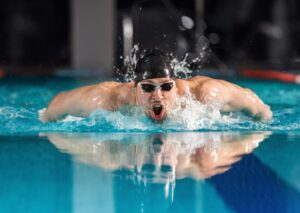
Butterfly: Maintaining Balance During the Wave Motion
Butterfly places exceptional demands on body position because breathing, propulsion, and the dolphin kick all occur simultaneously.
Your goal is to maintain a stable body line despite the vertical undulation. The wave motion should remain smooth and centered.
Avoid excessive bending at the waist or hips, as this immediately disrupts coordination and increases drag.
Coach’s Drill: Swim single-arm butterfly while holding a kickboard with the opposite hand.
🎯 Focus on maintaining a centered body line without excessive vertical or lateral movement.
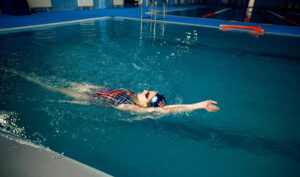
Backstroke: Staying Aligned Without Looking Forward
Backstroke presents a unique challenge because swimmers cannot see where they are going. Good body position therefore depends heavily on core stability and symmetrical movement.
Keep your body close to the surface while avoiding excessive rolling from side to side. Flutter kicks play a key role in maintaining stability.
Your hips should remain high to minimize drag and preserve proper alignment.
Coach’s Drill: swim backstroke with one arm resting alongside your body while the other arm performs the stroke.
🎯 This drill highlights imbalances and teaches you how to stabilize your core.
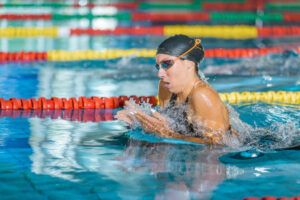
Breaststroke: Protecting the Glide
In breaststroke, balance is directly linked to the glide phase between strokes.
Avoid disrupting your streamlined position during the arm recovery and whip kick. Poor timing immediately increases drag and slows you down.
Breathing should remain smooth so that lifting the head does not break body alignment.
🎯 Coach’s Drill: Swim breaststroke while holding a two-second glide after every stroke cycle. Use this pause to feel how proper alignment improves efficiency.
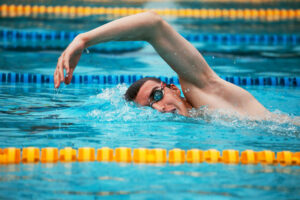
Freestyle: Staying Balanced While Rotating
Freestyle is an alternating stroke in which body rotation and side breathing constantly challenge your balance.
Your goal is to maintain a stable body line throughout every rotation. Core engagement plays a central role in preventing unnecessary movement.
Breathing should be integrated naturally by rotating the head without lifting the shoulders or upper body.
- Distance swimmers often use a two-beat kick, while sprinters typically employ a six-beat kick to increase stability and propulsion.
🎯 Coach’s Drill: swim freestyle using a pull buoy. By removing the kick from the equation, you can focus entirely on maintaining a stable upper body and a controlled body roll.
Body position is the foundation of every technical improvement in swimming. A stable body reduces drag, improves coordination, and allows every movement to become more efficient. By learning to control your alignment, breathing, buoyancy, and body position, you’ll swim farther, faster, and with less effort. Mastering balance isn’t a secondary skill—it’s one of the most powerful ways to unlock long-term swimming performance.